
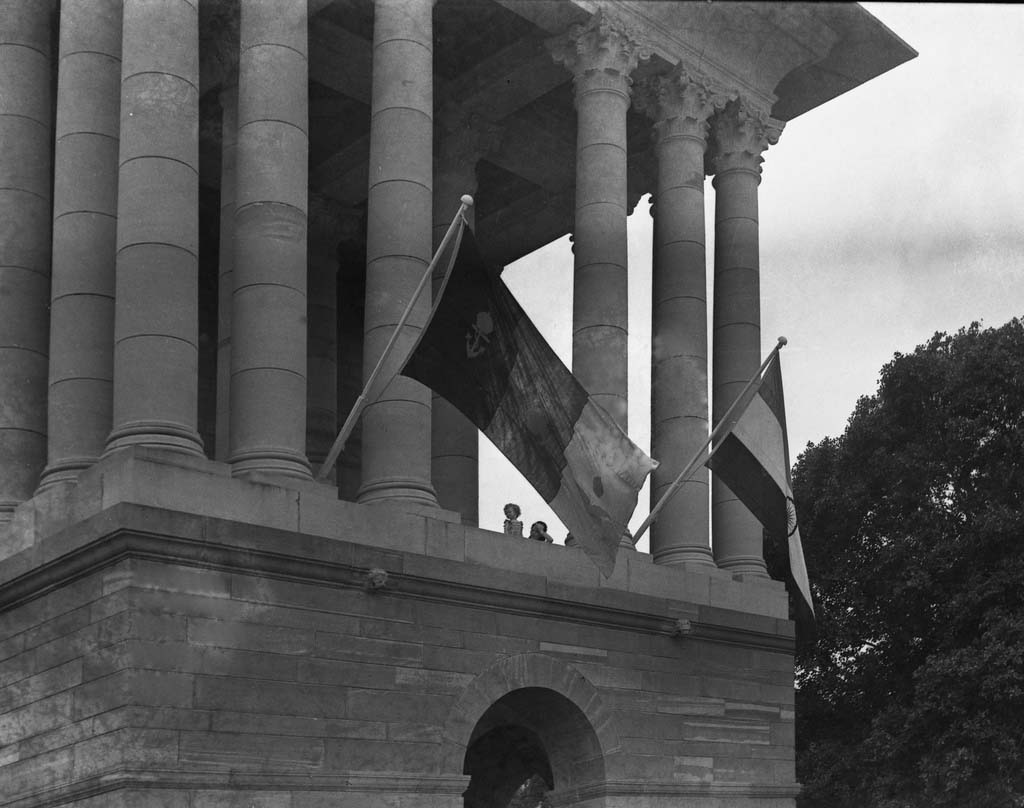
India's First Independence Day Celebrations in Delhi AUGUST 15, 1947
- Thread starter RAM
- Start date
More options
Who Replied?



ppgj
Senior Member
- Joined
- Aug 13, 2009
- Messages
- 2,029
- Likes
- 168
Tryst with Destiny was a speech made by Jawaharlal Nehru, the first Prime Minister of independent India. The speech was made to the Indian Constituent Assembly, on the eve of India's independence, towards midnight on August 14, 1947. It focuses on the aspects that transcend India's history. It is considered in modern India to be a landmark oration that captures the essence of the triumphant culmination of the hundred-year Indian freedom struggle against the British Empire in India.
....................................................................
Long years ago we made a tryst with destiny, and now the time comes when we shall redeem our pledge, not wholly or in full measure, but very substantially. At the stroke of the midnight hour, when the world sleeps, India will awake to life and freedom. A moment comes, which comes but rarely in history, when we step out from the old to the new, when an age ends, and when the soul of a nation, long suppressed, finds utterance. It is fitting that at this solemn moment we take the pledge of dedication to the service of India and her people and to the still larger cause of humanity.
At the dawn of history India started on her unending quest, and trackless centuries are filled with her striving and the grandeur of her success and her failures. Through good and ill fortune alike she has never lost sight of that quest or forgotten the ideals which gave her strength. We end today a period of ill fortune and India discovers herself again. The achievement we celebrate today is but a step, an opening of opportunity, to the greater triumphs and achievements that await us. Are we brave enough and wise enough to grasp this opportunity and accept the challenge of the future?
Freedom and power bring responsibility. The responsibility rests upon this Assembly, a sovereign body representing the sovereign people of India. Before the birth of freedom we have endured all the pains of labour and our hearts are heavy with the memory of this sorrow. Some of those pains continue even now. Nevertheless, the past is over and it is the future that beckons to us now.
That future is not one of ease or resting but of incessant striving so that we may fulfil the pledges we have so often taken and the one we shall take today. The service of India means the service of the millions who suffer. It means the ending of poverty and ignorance and disease and inequality of opportunity. The ambition of the greatest man of our generation has been to wipe every tear from every eye. That may be beyond us, but as long as there are tears and suffering, so long our work will not be over.
And so we have to labour and to work, and work hard, to give reality to our dreams. Those dreams are for India, but they are also for the world, for all the nations and peoples are too closely knit together today for any one of them to imagine that it can live apart Peace has been said to be indivisible; so is freedom, so is prosperity now, and so also is disaster in this One World that can no longer be split into isolated fragments.
To the people of India, whose representatives we are, we make an appeal to join us with faith and confidence in this great adventure. This is no time for petty and destructive criticism, no time for ill-will or blaming others. We have to build the noble mansion of free India where all her children may dwell.
The appointed day has come-the day appointed by destiny-and India stands forth again, after long slumber and struggle, awake, vital, free and independent. The past clings on to us still in some measure and we have to do much before we redeem the pledges we have so often taken. Yet the turning-point is past, and history begins anew for us, the history which we shall live and act and others will write about.
It is a fateful moment for us in India, for all Asia and for the world. A new star rises, the star of freedom in the East, a new hope comes into being, a vision long cherished materializes. May the star never set and that hope never be betrayed!
We rejoice in that freedom, even though clouds surround us, and many of our people are sorrowstricken and difficult problems encompass us. But freedom brings responsibilities and burdens and we have to face them in the spirit of a free and disciplined people.
On this day our first thoughts go to the architect of this freedom, the Father of our Nation [Gandhi], who, embodying the old spirit of India, held aloft the torch of freedom and lighted up the darkness that surrounded us. We have often been unworthy followers of his and have strayed from his message, but not only we but succeeding generations will remember this message and bear the imprint in their hearts of this great son of India, magnificent in his faith and strength and courage and humility. We shall never allow that torch of freedom to be blown out, however high the wind or stormy the tempest.
Our next thoughts must be of the unknown volunteers and soldiers of freedom who, without praise or reward, have served India even unto death.
We think also of our brothers and sisters who have been cut off from us by political boundaries and who unhappily cannot share at present in the freedom that has come. They are of us and will remain of us whatever may happen, and we shall be sharers in their good and ill fortune alike.
The future beckons to us. Whither do we go and what shall be our endeavour? To bring freedom and opportunity to the common man, to the peasants and workers of India; to fight and end poverty and ignorance and disease; to build up a prosperous, democratic and progressive nation, and to create social, economic and political institutions which will ensure justice and fullness of life to every man and woman.
We have hard work ahead. There is no resting for any one of us till we redeem our pledge in full, till we make all the people of India what destiny intended them to be. We are citizens of a great country on the verge of bold advance, and we have to live up to that high standard. All of us, to whatever religion we may belong, are equally the children of India with equal rights, privileges and obligations. We cannot encourage communalism or narrow-mindedness, for no nation can be great whose people are narrow in thought or in action.
To the nations and peoples of the world we send greetings and pledge ourselves to cooperate with them in furthering peace, freedom and democracy.
And to India, our much-loved motherland, the ancient, the eternal and the ever-new, we pay our reverent homage and we bind ourselves afresh to her service.
Tryst with destiny - Wikipedia, the free encyclopedia
....................................................................
Long years ago we made a tryst with destiny, and now the time comes when we shall redeem our pledge, not wholly or in full measure, but very substantially. At the stroke of the midnight hour, when the world sleeps, India will awake to life and freedom. A moment comes, which comes but rarely in history, when we step out from the old to the new, when an age ends, and when the soul of a nation, long suppressed, finds utterance. It is fitting that at this solemn moment we take the pledge of dedication to the service of India and her people and to the still larger cause of humanity.
At the dawn of history India started on her unending quest, and trackless centuries are filled with her striving and the grandeur of her success and her failures. Through good and ill fortune alike she has never lost sight of that quest or forgotten the ideals which gave her strength. We end today a period of ill fortune and India discovers herself again. The achievement we celebrate today is but a step, an opening of opportunity, to the greater triumphs and achievements that await us. Are we brave enough and wise enough to grasp this opportunity and accept the challenge of the future?
Freedom and power bring responsibility. The responsibility rests upon this Assembly, a sovereign body representing the sovereign people of India. Before the birth of freedom we have endured all the pains of labour and our hearts are heavy with the memory of this sorrow. Some of those pains continue even now. Nevertheless, the past is over and it is the future that beckons to us now.
That future is not one of ease or resting but of incessant striving so that we may fulfil the pledges we have so often taken and the one we shall take today. The service of India means the service of the millions who suffer. It means the ending of poverty and ignorance and disease and inequality of opportunity. The ambition of the greatest man of our generation has been to wipe every tear from every eye. That may be beyond us, but as long as there are tears and suffering, so long our work will not be over.
And so we have to labour and to work, and work hard, to give reality to our dreams. Those dreams are for India, but they are also for the world, for all the nations and peoples are too closely knit together today for any one of them to imagine that it can live apart Peace has been said to be indivisible; so is freedom, so is prosperity now, and so also is disaster in this One World that can no longer be split into isolated fragments.
To the people of India, whose representatives we are, we make an appeal to join us with faith and confidence in this great adventure. This is no time for petty and destructive criticism, no time for ill-will or blaming others. We have to build the noble mansion of free India where all her children may dwell.
The appointed day has come-the day appointed by destiny-and India stands forth again, after long slumber and struggle, awake, vital, free and independent. The past clings on to us still in some measure and we have to do much before we redeem the pledges we have so often taken. Yet the turning-point is past, and history begins anew for us, the history which we shall live and act and others will write about.
It is a fateful moment for us in India, for all Asia and for the world. A new star rises, the star of freedom in the East, a new hope comes into being, a vision long cherished materializes. May the star never set and that hope never be betrayed!
We rejoice in that freedom, even though clouds surround us, and many of our people are sorrowstricken and difficult problems encompass us. But freedom brings responsibilities and burdens and we have to face them in the spirit of a free and disciplined people.
On this day our first thoughts go to the architect of this freedom, the Father of our Nation [Gandhi], who, embodying the old spirit of India, held aloft the torch of freedom and lighted up the darkness that surrounded us. We have often been unworthy followers of his and have strayed from his message, but not only we but succeeding generations will remember this message and bear the imprint in their hearts of this great son of India, magnificent in his faith and strength and courage and humility. We shall never allow that torch of freedom to be blown out, however high the wind or stormy the tempest.
Our next thoughts must be of the unknown volunteers and soldiers of freedom who, without praise or reward, have served India even unto death.
We think also of our brothers and sisters who have been cut off from us by political boundaries and who unhappily cannot share at present in the freedom that has come. They are of us and will remain of us whatever may happen, and we shall be sharers in their good and ill fortune alike.
The future beckons to us. Whither do we go and what shall be our endeavour? To bring freedom and opportunity to the common man, to the peasants and workers of India; to fight and end poverty and ignorance and disease; to build up a prosperous, democratic and progressive nation, and to create social, economic and political institutions which will ensure justice and fullness of life to every man and woman.
We have hard work ahead. There is no resting for any one of us till we redeem our pledge in full, till we make all the people of India what destiny intended them to be. We are citizens of a great country on the verge of bold advance, and we have to live up to that high standard. All of us, to whatever religion we may belong, are equally the children of India with equal rights, privileges and obligations. We cannot encourage communalism or narrow-mindedness, for no nation can be great whose people are narrow in thought or in action.
To the nations and peoples of the world we send greetings and pledge ourselves to cooperate with them in furthering peace, freedom and democracy.
And to India, our much-loved motherland, the ancient, the eternal and the ever-new, we pay our reverent homage and we bind ourselves afresh to her service.
Tryst with destiny - Wikipedia, the free encyclopedia


ppgj
Senior Member
- Joined
- Aug 13, 2009
- Messages
- 2,029
- Likes
- 168
video of part of the nehru speech-
YouTube - Tryst With Destiny
YouTube - Tryst With Destiny




ppgj
Senior Member
- Joined
- Aug 13, 2009
- Messages
- 2,029
- Likes
- 168


- Joined
- Oct 10, 2009
- Messages
- 3,779
- Likes
- 2,666

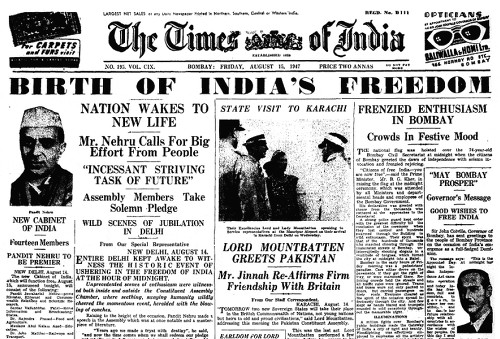
THE TIMES OF INDIA FRONTPAGE on August 15th 1947

Times of India
Times of India
ppgj
Senior Member
- Joined
- Aug 13, 2009
- Messages
- 2,029
- Likes
- 168
MK Gandhi's Speech (Real un-edited Voice) at geneva.
YouTube - MK Gandhi's Speech (Real un-edited Voice)
YouTube - MK Gandhi's Speech (Real un-edited Voice)
ppgj
Senior Member
- Joined
- Aug 13, 2009
- Messages
- 2,029
- Likes
- 168
ppgj
Senior Member
- Joined
- Aug 13, 2009
- Messages
- 2,029
- Likes
- 168

- Joined
- Jul 15, 2009
- Messages
- 2,288
- Likes
- 445
Nehruvian Moments

Mahatma Gandhi in conversation with Pandit Nehru at Howrah Station before Gandhiji's departure from Calcutta

Congress President Netaji Subhas Chandra Bose and Pandit Jawaharlal Nehru engaged in a brief conversation, before the latter announced his resignation from the Congress presidentship. Frontier Gandhi, Khan Abdul Gaffar Khan, and Babu Rajendra Prasad can be seen in the background.

THE TRICOLOUR: Pandit Jawaharlal Nehru, Vice President, Interim Government, holds the silk flag. The flag was adopted as the national flag by the constitutent assembly at New Delhi.
Mahatma Gandhi in conversation with Pandit Nehru at Howrah Station before Gandhiji's departure from Calcutta
Congress President Netaji Subhas Chandra Bose and Pandit Jawaharlal Nehru engaged in a brief conversation, before the latter announced his resignation from the Congress presidentship. Frontier Gandhi, Khan Abdul Gaffar Khan, and Babu Rajendra Prasad can be seen in the background.
THE TRICOLOUR: Pandit Jawaharlal Nehru, Vice President, Interim Government, holds the silk flag. The flag was adopted as the national flag by the constitutent assembly at New Delhi.
- Joined
- Jul 15, 2009
- Messages
- 2,288
- Likes
- 445
INDUSTRIALISING INDIA

Jawaharlal Nehru, who declared open the Indian Rare Earths Factory at Alwaye, Travancore - Cochin, is on a conducted of the factory. (Left to right) : Dr.H.J.Bhabha, Dr.S.S.Bhatnagar, Shri K.R.K. Menon, Shri Jawaharlal Nehru, The Rajpramukh of Travancore-Cochin and Shri Lal Bhahadur Shastri.
BUILDING INSTITUTIONS

Dr. Rajendra Prasad, opened the new building of the Indian Institute of Public Administration in New Delhi on January 31, 1959. Photo shows the President and the Prime Minister, Jawaharlal Nehru, with members of the Executive Council and staff of the Institute
POLITICS OF THE DAY

Jawaharlal Nehru and Mohammed Ali Jinnah about to leave for Birla House, Delhi, to see Mahatma Gandhi in this undated photo.
Jawaharlal Nehru, who declared open the Indian Rare Earths Factory at Alwaye, Travancore - Cochin, is on a conducted of the factory. (Left to right) : Dr.H.J.Bhabha, Dr.S.S.Bhatnagar, Shri K.R.K. Menon, Shri Jawaharlal Nehru, The Rajpramukh of Travancore-Cochin and Shri Lal Bhahadur Shastri.
BUILDING INSTITUTIONS
Dr. Rajendra Prasad, opened the new building of the Indian Institute of Public Administration in New Delhi on January 31, 1959. Photo shows the President and the Prime Minister, Jawaharlal Nehru, with members of the Executive Council and staff of the Institute
POLITICS OF THE DAY
Jawaharlal Nehru and Mohammed Ali Jinnah about to leave for Birla House, Delhi, to see Mahatma Gandhi in this undated photo.
- Joined
- Jul 15, 2009
- Messages
- 2,288
- Likes
- 445
COUNTDOWN TO FREEDOM

Pandit Jawaharlal Nehru and his six colleagues who were sworn in on Sept. 2, 1946 as members of the Interim Government met the press informally the same afternoon. Pandit Nehru addressed the press for half an hour on the tasks before the new Government formed by him
MAKING A REPUBLIC

The Britain's Prime Minister, Clement Attlee enjoys a joke with Jawaharlal Nehru, Indian Premier, and Dr. Daniel Malan, South African Premier, at the sherry party given at No.10, Downing Street, London. The Commonwealth Premiers met to discuss India's decision to become a republic.
MEETING THE NIZAM

Pandit Jawaharlal Nehru welcomed by His Exalted Highness, the Nizam of Hyderabad at King Kothi Palace in Hyderabad on Dec. 25, 1948, when the Prime Minister called on the Nizam.
Pandit Jawaharlal Nehru and his six colleagues who were sworn in on Sept. 2, 1946 as members of the Interim Government met the press informally the same afternoon. Pandit Nehru addressed the press for half an hour on the tasks before the new Government formed by him
MAKING A REPUBLIC
The Britain's Prime Minister, Clement Attlee enjoys a joke with Jawaharlal Nehru, Indian Premier, and Dr. Daniel Malan, South African Premier, at the sherry party given at No.10, Downing Street, London. The Commonwealth Premiers met to discuss India's decision to become a republic.
MEETING THE NIZAM
Pandit Jawaharlal Nehru welcomed by His Exalted Highness, the Nizam of Hyderabad at King Kothi Palace in Hyderabad on Dec. 25, 1948, when the Prime Minister called on the Nizam.
- Joined
- Jul 15, 2009
- Messages
- 2,288
- Likes
- 445
WITH MAHARAJA

The Prime Minister, Pandit Jawaharlal Nehru is being introduced to the State officials on his arrival at Mysore Aerodrome on December 31, 1948. Also seen in the picture is His Highness the Maharaja of Mysore (extreme left)
RECOGNISING A SCHOLAR

Pandit Jawaharlal Nehru, the Prime Minister of India, addressed the `Special Convocation' of the Mysore University at the Crawford Hall at Mysore, where the Honorary Degree of Doctor of Science was conferred on him by His Highness the Maharaja of Mysore (the Chancellor) on December 28, 1948
A DISCOVERER OF INDIA:

Pandit Jawaharlal Nehru taking a keen look at the bronze statue of the Vijayanagara emperor Sri Krishna Devaraya, installed inside the Tirumala temple complex.
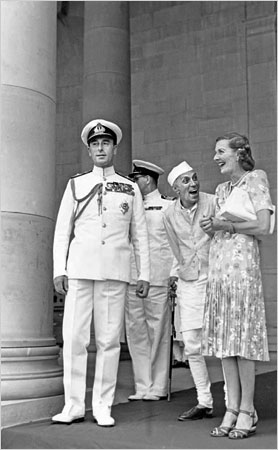
The Prime Minister, Pandit Jawaharlal Nehru is being introduced to the State officials on his arrival at Mysore Aerodrome on December 31, 1948. Also seen in the picture is His Highness the Maharaja of Mysore (extreme left)
RECOGNISING A SCHOLAR
Pandit Jawaharlal Nehru, the Prime Minister of India, addressed the `Special Convocation' of the Mysore University at the Crawford Hall at Mysore, where the Honorary Degree of Doctor of Science was conferred on him by His Highness the Maharaja of Mysore (the Chancellor) on December 28, 1948
A DISCOVERER OF INDIA:
Pandit Jawaharlal Nehru taking a keen look at the bronze statue of the Vijayanagara emperor Sri Krishna Devaraya, installed inside the Tirumala temple complex.
- Joined
- Jul 15, 2009
- Messages
- 2,288
- Likes
- 445

Pandit Nehru with councillors of the Madras Corporation at the civic reception extended to the Congress President in Madras.
SCIENTIFIC TEMPER

Jawaharlal Nehru at the Pasteur Institute of India in Coonoor in this undated photo. Digital image: K. Anandan
PREMIER AT WORK

Jawaharlal Nehru with K.D. Malaviya, former Union Minister for Petroleum
- Joined
- Jul 15, 2009
- Messages
- 2,288
- Likes
- 445
LEADERS OF A NATION

C. Rajagopalachari (Rajaji), Pandit Jawaharlal Nehru and the President, Dr. Rajendra Prasad share a lighter moment at an 'At Home' given in honour of Rajaji at Rashtrapati Bhavan in New Delhi on the evening of Octoebr 25, 1957
REPUBLICAN MOMENT

Shri Rajgopalachari's departure as the country's last Governor-General took place on Jan. 27, 1950, with full state honours at Palam Airport. He was seen off by the President, members of the Cabinet and the diplomatic corps. Photo shows Pandit Nehru presenting a "saffron flower" from Kashmir to Rajaji.
PRIME MINISTER

Pandit Jawaharlal Nehru being sworn-in as Prime Minister of India, by the President, Dr. Rajendra Prasad in the presence of other Cabinet colleagues at the Rashtrapati Bhavan in New Delhi on May 14, 1952.
C. Rajagopalachari (Rajaji), Pandit Jawaharlal Nehru and the President, Dr. Rajendra Prasad share a lighter moment at an 'At Home' given in honour of Rajaji at Rashtrapati Bhavan in New Delhi on the evening of Octoebr 25, 1957
REPUBLICAN MOMENT
Shri Rajgopalachari's departure as the country's last Governor-General took place on Jan. 27, 1950, with full state honours at Palam Airport. He was seen off by the President, members of the Cabinet and the diplomatic corps. Photo shows Pandit Nehru presenting a "saffron flower" from Kashmir to Rajaji.
PRIME MINISTER
Pandit Jawaharlal Nehru being sworn-in as Prime Minister of India, by the President, Dr. Rajendra Prasad in the presence of other Cabinet colleagues at the Rashtrapati Bhavan in New Delhi on May 14, 1952.
- Joined
- Jul 15, 2009
- Messages
- 2,288
- Likes
- 445
ENGAGING NEIGHBOURS

With the Maharajah. Picture shows (from left to right): B. K. Kapur, Chief of Protocol, Government of India, Chatterjee, Military Secretary to President, Jawaharlal Nehru, His Highness the Maharaja Mohan Shamsher Jang Bahadur Rana, Sardar Baldev Singh and General Sharda Shamsher Jang Bahadur Rana of Nepal at a reception to His Highness the Maharaja, the Prime Minister and Supreme Commander-in-Chief of Nepal at New Delhi Railway Station on February 17, 1950.
WELCOME TO INDIA

Prime Minister of United Kingdom, Harold Macmillan, who arrived at Delhi Airport on January 8, 1958 on a four-day visit to India, seen leaving the airport in an open convertible car with the Indian Prime Minister, Jawaharlal Nehru.
WORLD LEADERS

The Prime Minister of India, Jawaharlal Nehru, with the U.S. President, John F Kennedy, in the White House garden during his visit to U.S. in 1962.
With the Maharajah. Picture shows (from left to right): B. K. Kapur, Chief of Protocol, Government of India, Chatterjee, Military Secretary to President, Jawaharlal Nehru, His Highness the Maharaja Mohan Shamsher Jang Bahadur Rana, Sardar Baldev Singh and General Sharda Shamsher Jang Bahadur Rana of Nepal at a reception to His Highness the Maharaja, the Prime Minister and Supreme Commander-in-Chief of Nepal at New Delhi Railway Station on February 17, 1950.
WELCOME TO INDIA
Prime Minister of United Kingdom, Harold Macmillan, who arrived at Delhi Airport on January 8, 1958 on a four-day visit to India, seen leaving the airport in an open convertible car with the Indian Prime Minister, Jawaharlal Nehru.
WORLD LEADERS
The Prime Minister of India, Jawaharlal Nehru, with the U.S. President, John F Kennedy, in the White House garden during his visit to U.S. in 1962.
- Joined
- Jul 15, 2009
- Messages
- 2,288
- Likes
- 445
WELCOMING ROYALTY

President, Dr. Rajendra Prasad, the Vice President, Dr. S. Radhakrishnan and the Prime Minister, Jawaharlal Nehru, receive Their Imperial Majesties, the Shahanshah and Empress of Iran at Palam Airport in Delhi on February 16, 1956.
IN CHINA

Lin Shao-Chi, chairman of the standing committee of the National People's Congress of the People's Republic of China, Pandit Nehru, Chu Teh, Vice Chairman of China at a tea reception to Mr. Nehru in Peking on October 23, 1954.
REDEFINING A NATION

The congress executive meets at the Prime Minister's residence in New Delhi to discuss the reorganisation of States on Dec. 23, 1955. The Prime Minister Pandit Nehru addressing the meeting, Dr. Sayed Mahmoud , Maulana Azad and Dr. Katju are seen in the picture.
IN CONVERSATION

Prime Minister Jawaharlal Nehru with Defence Minister Krishna Menon in Delhi on Oct. 25, 1962.
President, Dr. Rajendra Prasad, the Vice President, Dr. S. Radhakrishnan and the Prime Minister, Jawaharlal Nehru, receive Their Imperial Majesties, the Shahanshah and Empress of Iran at Palam Airport in Delhi on February 16, 1956.
IN CHINA
Lin Shao-Chi, chairman of the standing committee of the National People's Congress of the People's Republic of China, Pandit Nehru, Chu Teh, Vice Chairman of China at a tea reception to Mr. Nehru in Peking on October 23, 1954.
REDEFINING A NATION
The congress executive meets at the Prime Minister's residence in New Delhi to discuss the reorganisation of States on Dec. 23, 1955. The Prime Minister Pandit Nehru addressing the meeting, Dr. Sayed Mahmoud , Maulana Azad and Dr. Katju are seen in the picture.
IN CONVERSATION
Prime Minister Jawaharlal Nehru with Defence Minister Krishna Menon in Delhi on Oct. 25, 1962.


Latest Replies
-
 Indian Special Forces
- COLDHEARTED AVIATOR
-
 Indian Navy Developments & Discussions
- Smoothbore125mm
-
 Small arms and Light Weapons
- VictorDelta4
-
 Jokes Thread
- Hindu Nationalist
-
 Russia Ukraine War 2022
- Hari Sud


Global Defence
-
Small arms and Light Weapons
- VictorDelta4
-
 Turkish defense industry news updates
- mamamia12
-
 Aircraft Crash Notification
- vishnugupt
-
 Drone swarms -India
- LETHALFORCE
-
 F-35 Joint Strike Fighter
- blackjack
-
 World Military/Paramilitary/Special Forces
- airborneCommando
-
 New Naval Technology
- Blademaster
-
 F-16 Viper
- MiG-29SMT
New threads
-
 World Chess Championship 2024
- SwordOfDarkness
- Replies: 4
-
 Chinese Lunar Exploration Program
- skywatcher
- Replies: 0
Articles
-
 India Strikes Back: Operation Snow Leopard - Part 1
- mist_consecutive
- Replies: 9
-
Aftermath Galwan : Who holds the fort ?
- mist_consecutive
- Replies: 33
-
 The Terrible Cost of Presidential Racism(Nixon & Kissinger towards India).
- ezsasa
- Replies: 40
-
Modern BVR Air Combat - Part 2
- mist_consecutive
- Replies: 22
-
Civil & Military Bureaucracy and related discussions
- daya
- Replies: 32